March 2026
Creative Tech
Theoretical
Graphic Design
Everyone's talking about 3D printing, but what about 2D printing?
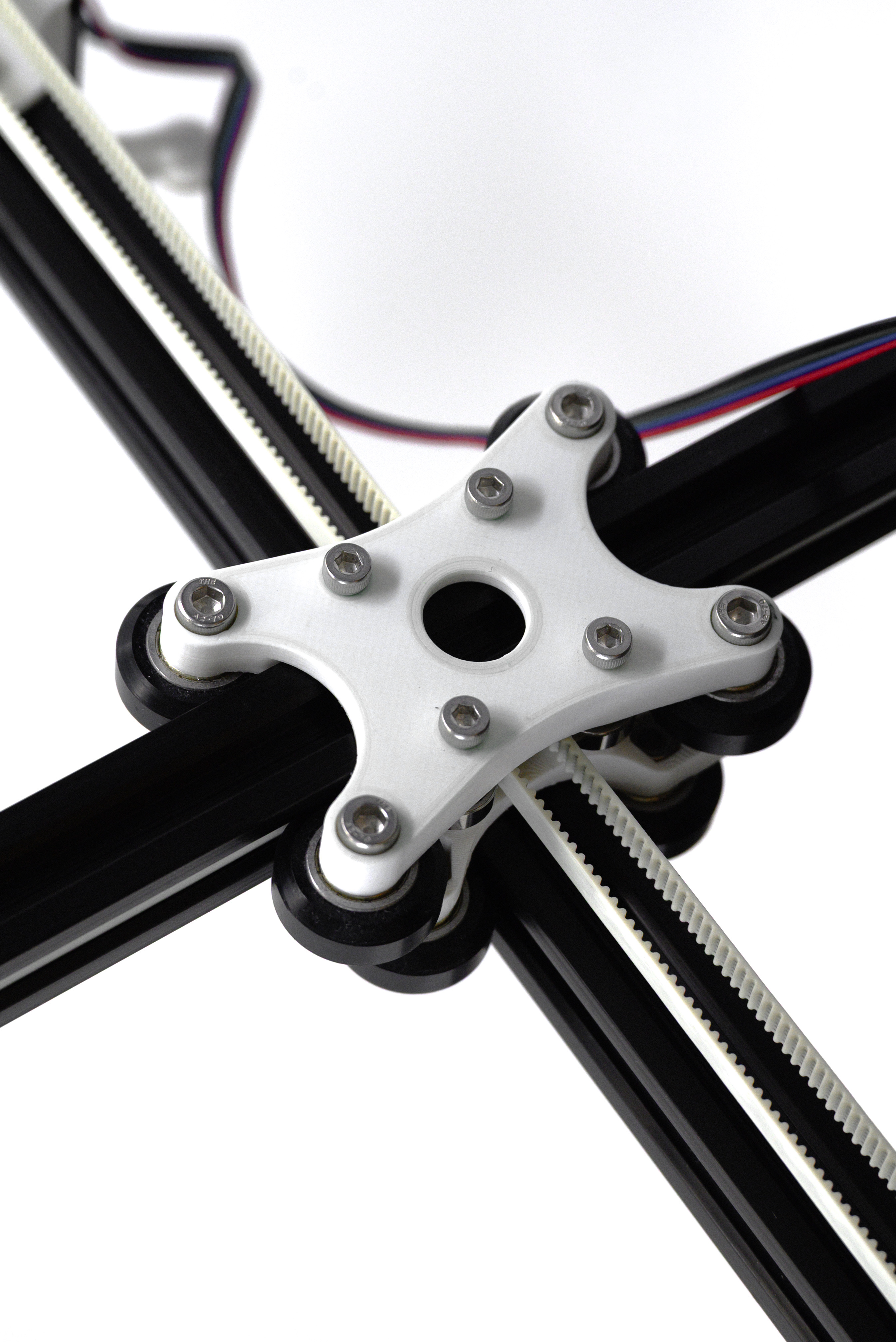
This is a pen plotter I designed and built from scratch — a machine that translates digital vector data into physical drawings with a level of precision and legibility that more complex printing technologies often can't match.
Digital environments can be abstract and disconnected from reality. In relation to manufacturing, that abstraction works against the designer. The physical world pushes back. Designing in software and transferring it to the real world is an exercise in understanding real constraints. In 3D printing, the thickness of a supporting structure or the fineness of a detail suddenly becomes apparent. In pen plotting, the weight of the ink or the diameter of the pen tip can inform the process in ways you'd never anticipate on screen.
This project is part of a broader practice exploring digital translation into the physical—the space where CNC technologies, parametric modeling, and creative coding meet the real world.
The plotter runs on aluminum v-slot rail with off-the-shelf electronics, but every 3D-printed component was designed and engineered by me in Rhino and Fusion 360. I started in Rhino for initial form exploration, then migrated to Fusion as the project grew more complex—parametric constraints and McMaster-Carr component libraries became essential for designing around real fasteners, bearings, and tolerances.
The pen holder went through multiple iterations. Early versions were too small, couldn't print without supports, or were too unstable on the gantry. Each failure surfaced a new constraint that refined the final design.
I'm currently developing drawing algorithms using generative code—exploring what happens when the art itself is as computationally designed as the machine producing it.
March 2026
Creative Tech
Theoretical
Graphic Design